

du@xllwire.com


✕



Electric vehicle (EV) connectors must operate reliably in environments with severe vibration, thermal cycling, damp exposure and high temperatures. Adhesives and sealants applied to connector housings, cable entrances and end points can significantly enhance sealing performance, vibration damping capacity and mechanical stability. These materials may also introduce long-term failure modes due to factors such as mismatched thermal expansion, chemical aging and environmental degradation. This article elaborates on how adhesives and sealants enhance the reliability of connectors through moisture-proof layers, vibration damping, and mechanical stabilization. Meanwhile, this paper also reviews the aging mechanisms that lead to performance degradation during the service life of vehicles, including thermal cycling damage, material hardening or softening, and moisture-assisted debonding. At the end of the article, trade-offs for high-voltage power connectors, low-voltage signal connectors and PCB mounting components in specific applications are proposed.
The mechanism for enhancing the reliability of connectors
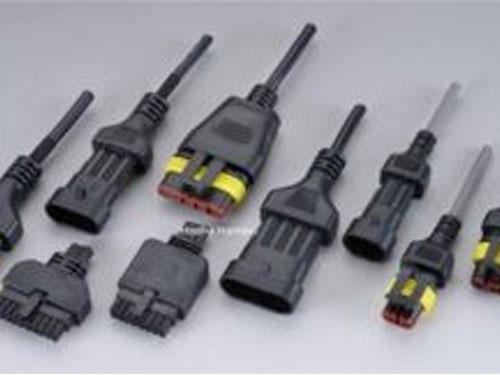
Adhesives and sealants enhance connector performance through four main mechanisms: Moisture and contaminant barrier: Gasket sealant, potting compound and secondary molded parts form a continuous barrier layer, which can prevent moisture, road salt and coolant from entering, reducing corrosion at the contact interface and crimped terminals. Bonded elastomer secondary molded parts seal the complex geometers of busbars and power distribution components more reliably than independent O-rings or compression gaskets. Shock absorption and mechanical stability: The elastomer and filling potting compound absorb shock and limit the minute displacement of terminals, solder joints and crimping connections, reducing wear, solder joint fatigue and wire breakage under continuous vibration. Structural and semi-structural adhesives distribute mechanical loads between the housing and the mounting bracket, minimizing local stress concentration at the connector interface. Stress relief and cable fixation: Adhesive beads or secondary molded parts applied at the cable outlet points can reduce cyclic bending stress and prevent the sheath or rear shell from gradually loosening. This fixing measure maintains the sealing integrity under vibration and prevents moisture from entering. Thermal and chemical protection: Many automotive-grade adhesives can withstand the temperature of battery packs and come into contact with ethylene glycol-based coolants and lubricants. Adhesive seals are generally more stable than mechanically compressed elastomer seals, which may relax or creep under continuous compression and high temperatures. As shown in Figure 1, the overmolded elastomer sleeve at the cable outlet of the connector integrates stress relief and environmental sealing, reducing cyclic bending stress and maintaining sealing integrity under vibration.
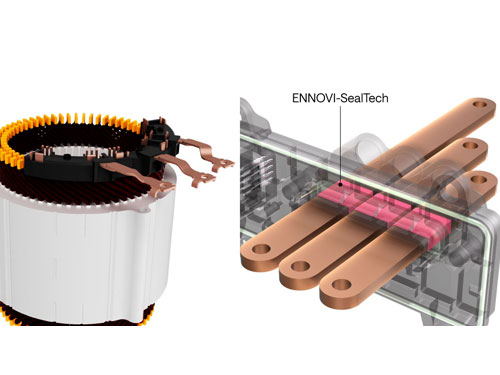
The high-current busbar connection demonstrates this design approach. As shown in Figure 2, the adhesive elastomer seal around the conductor provides coolant sealing and mechanical fixation, minimizing cracking caused by vibration at bolted connections or welded terminals.
Long-term aging and failure mechanisms
When the material or interface properties do not match the working conditions, the performance of adhesives and sealants will decline. Four mechanisms typically lead to this risk: thermal expansion mismatch and interface cracking, material hardening or softening, chemical degradation, and moisture-assisted debonding. Thermal expansion mismatch is usually the main driving factor. The difference in the coefficient of thermal expansion among adhesives, plastic casings and metal terminals generates shear stress during thermal cycling. Repeated temperature fluctuations cause microcracks and progressive debonding at the material interface. Once cracks form, moisture channels will be created, increasing the stress concentration in the remaining bonding area. Material hardening or softening is another major driving factor. Some epoxy systems become brittle after thermal aging, while certain polyurethane or silicone formulations soften or creep under continuous high-temperature compression. Brittle materials can transfer more vibration energy and may break under impact. Overly softened materials will lose their sealing force, causing the connector gasket to produce a pumping effect under vibration, thereby reducing environmental protection performance. Chemical degradation is also an important aging mechanism. Coolants, oils and cleaning fluids can release plasticizers or chemically attack the polymer network, thereby weakening the adhesion and altering the elastic modulus. In battery systems, long-term exposure to ethylene glycol-water mixtures is a known cause of premature failure of sealants. Moisture-assisted debonding is another key failure mode. The absorbed moisture reduces the glass transition temperature, causes the polymer network to expand, and degrades the interfacial adhesion. Repeated absorption and desorption cycles accelerate the damage between the adhesive and the substrate. In severe cases, moisture and high temperature work together to produce cavitation and progressive stratification. Fretting corrosion introduces additional reliability risks at the partially debonding interface. When the flexible potting layer cracks or separates, the interface may still allow for slight movement, while trapping moisture and oxygen, accelerating the corrosion of the contact surface. An increase in contact resistance may lead to catastrophic failure
Connector category and design trade-offs
Due to differences in voltage, current capacity, environmental exposure and service capability, adhesive and sealant strategies vary by connector type. There are differences in design priorities and failure risks among the three main connector categories High-voltage power connectors and busbars: Priority should be given to creepage distance and electrical clearance, coolant sealing, arc flash control, and structural retention. The bonded elastomer molded parts and potting provide coolant-resistant seals, stabilize busbars, and maintain insulation spacing. Due to the serious consequences that fluid leakage or electric arcs can cause, sealing and mechanical fixation are of vital importance. Meanwhile, the large area of copper sections and the steep thermal gradient increase the risk of thermal expansion mismatch. Potting effectively eliminates the service capacity, so the reliability of the long-term adhesive is given more attention. Low-voltage signal and control connectors: Emphasizing stable contact resistance, electromagnetic compatibility, corrosion resistance and field service capability. Common methods include edge gaskets, gel intrusion barriers, and lightweight potting or stress relief. The additional seal offers moderate benefits because the contact points have high mechanical strength and are usually gold-plated to enhance corrosion resistance. Overpotting may increase solder stress and only provide limited incremental protection when an overall IP-grade gasket already exists. Therefore, permanent adhesives are usually avoided at the mating interface. Pcb-mounted connectors: When installed on circuit boards with heat-sensitive solder joints in battery management modules, inverter controllers and on-board chargers, they need to withstand high vibration and thermal cycling. Potting or encapsulation can provide effective damping and moisture-proof protection, but if rigid materials are used, it will increase the risk of solder joint fatigue. Soft, low-modulus silicone or flexible polyurethane can better adapt to the differential expansion between connectors and circuit boards. Once the assembled parts are potting, rework and inspection will become extremely difficult, resulting in potential defects remaining undetected until on-site failure.
Material selection criteria
As shown in Figure 3, the potting material encapsulates the surface mount components and connector terminals on the control module circuit board, providing shock absorption and environmental protection while adapting to thermal expansion.

For high-vibration environments, material selection tends to favor low to medium modulus materials with high ductility to achieve shock absorption and thermal expansion. Enhanced epoxy resin maintains high shear strength while improving peel resistance and thermal cycling tolerance. Polyurethane potting material strikes a balance between strength and flexibility in situations with significant thermal mismatch and impact loads, and effectively reduces shock. Silicone gel and elastomers offer a wide range of operating temperatures and exhibit excellent fatigue life in assemblies where there is a significant difference in expansion between metals and plastics.
Abstract
Adhesives and sealants enhance the reliability of electric vehicle connectors through environmental sealing, shock absorption and mechanical stabilization, reducing moisture intrusion, corrosion and wear at the contact interface. Long-term performance depends on the selection of materials that are compatible with thermal cycling, chemical exposure and substrate expansion. When the material or interface performance fails to meet the operational requirements, aging mechanisms such as thermal mismatch cracking, material hardening or softening, and water-assisted debonding will erode the initial reliability improvement. For high-voltage power connectors, low-voltage signal connectors and PCB mounting components, the strategies vary, reflecting different environmental requirements, maintainability demands and failure consequences.


